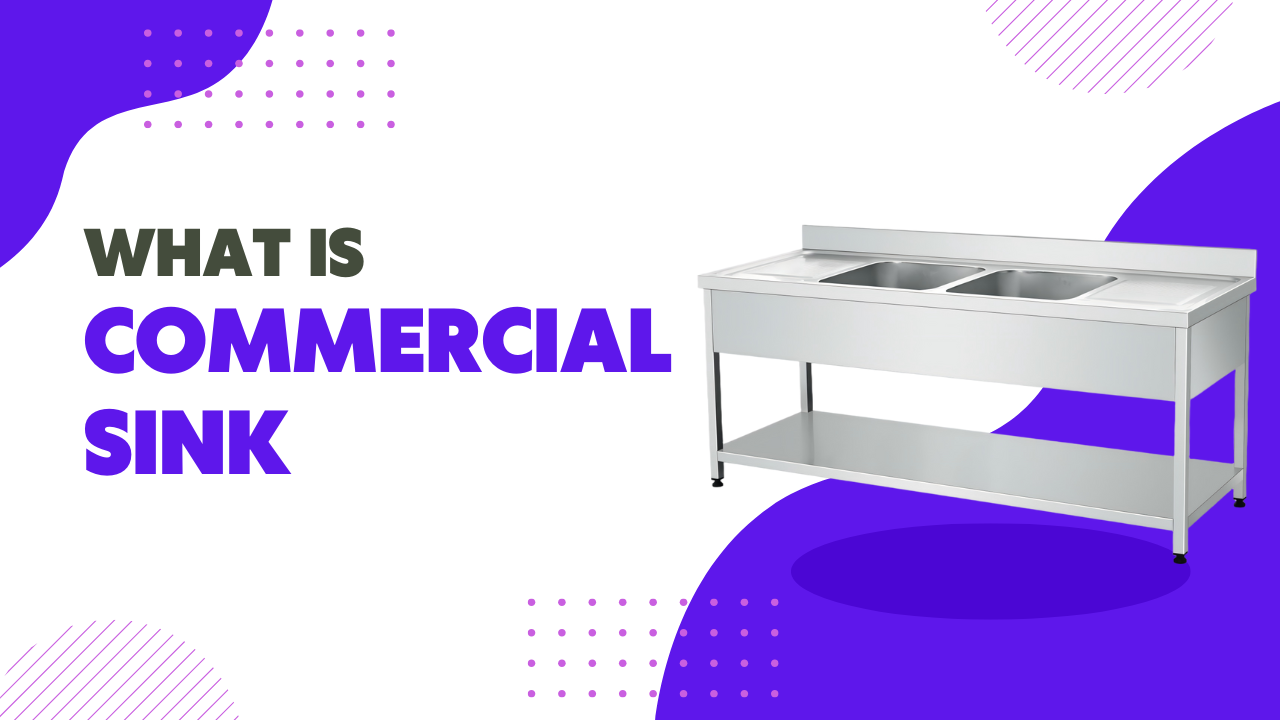
Commercial sinks are essential equipment in commercial kitchens. Today, we’ll introduce the two main types of commercial sinks. We’ll cover their characteristics and help you choose the right one for you. You’ll also learn how to assemble a commercial sink. Let’s get started!
What is Commercial Sink?
Commercial sinks are essential equipment designed for professional kitchens, where they are used to carry out rigorous cleaning, food handling, and ensure strict hygiene. Unlike household sinks, commercial sinks are typically constructed of industrial-grade stainless steel, with a thickness ranging from 0.8mm to 1.2mm, ensuring durability despite heavy use.
Freestanding commercial sink
A freestanding commercial sink is a sink that stands on four legs. It doesn’t need to be fixed to a wall and can be placed freely in any suitable work area. This type of sink is typically constructed from a deep draw or welded stainless steel basin. The legs are constructed from thickened stainless steel tubing and feature adjustable feet to ensure stability on varying floor surfaces. This standardized and customizable stainless steel sink is quick to install, simple to construct, and versatile.
Wall-mounted commercial sink
A wall-mounted commercial sink is a stainless steel sink that is installed directly on the wall using brackets or expansion bolts. The sink’s weight and operational load are primarily borne by the wall, placing high demands on the wall’s load-bearing capacity and secure mounting. This type of sink is typically manufactured using a deep-drawing or welding process. Since it doesn’t require support legs, wall-mounted sinks maximize floor space savings. They are ideal for work areas where space utilization is critical, making them a popular commercial sink style.
Pros and Cons of Two Sinks
Freestanding Commercial Sinks
Pros:
- Independently supported, with strong load-bearing capacity, suitable for storing large kitchen utensils and plates.
- Flexible installation, allowing for repositioning and rearrangement at any time.
- Configurable with lower shelves, backrests, drainboards, and more, offering strong expandability.
- Customizable size, depth, and thickness, with a high degree of standardization and wide applicability.
Disadvantages:
- Takes up floor space, making it unsuitable for small kitchens or those with tight traffic flow.
- Compared to wall-mounted sinks, the legs can hinder floor cleaning.
- Cost may be slightly higher than that of smaller wall-mounted sinks.
Wall-mounted Commercial Sinks
Pros:
- Requires minimal floor space, saving space and making it easy to keep the floor clean.
- Simple appearance, suitable for small to medium-sized kitchens or limited workspaces.
- Fixed mounting position, adjustable operating height, ergonomically designed. 4. Relatively low cost, suitable for lightweight cleaning and auxiliary work areas.
Disadvantages:
- Relying on the wall for support, installation conditions are limited and unsuitable for heavy loads.
- Typically smaller in size, their functional scalability is inferior to that of freestanding sinks.
- Once fixed in position, subsequent adjustments are difficult.
How to Install a Commercial Sink?
Freestanding Commercial Sink Installation Instructions
Unboxing Inspection: Verify that the sink, four legs, and screws are complete.
Leg Installation: Place the sink upside down on a soft cloth to prevent scratches. Insert the legs one at a time into the bottom sockets. Secure with the included screws/nuts, first by hand, then tighten with a wrench.
Finally, turn the sink upright and place it in its intended location. Verify that the sink is stable and free of wobbles.
Wall-Mount Commercial Sink Installation Instructions
Unboxing Inspection: Verify that the sink, expansion screws, and accessories are complete.
Determine the installation location based on your needs. Use a hammer drill to drill holes at the marked locations, ensuring the hole depth matches the expansion screw length. Insert the expansion screws and secure the sink with screws.
Drain Installation: Install the drain and drain pipe under the sink, applying a seal or adhesive to the joints.
Water Supply Connection: Install the faucet and secure it with the nuts. Turn on the water supply and check for leaks from the faucet and drain outlet. Gently shake the sink to ensure it is securely installed.
How to Choose Between a Freestanding and Wall-Mounted Sink?
In commercial kitchens, sinks are essential cleaning and handling equipment. Choosing a freestanding or wall-mounted commercial sink directly impacts your space layout, operational efficiency, and overall cost. Below, we’ll examine several key factors to help you determine which sink is best for your commercial kitchen.
1. Space Layout and Installation Location
Freestanding sinks: With four built-in legs, they’re easy to install and suitable for open kitchens and central countertops. They offer stability even on moderate floor conditions.
Wall-mounted sinks: Attached to the wall, they save floor space and are ideal for smaller kitchens with compact workspaces. However, this requires reliable load-bearing wall support.
Choice Recommendation: If your kitchen space is spacious, a freestanding sink offers greater flexibility; if space is limited, a wall-mounted sink offers greater floor space savings.
2. Load Capacity and Stability
Freestanding sinks: With adjustable legs, they can handle heavy loads and are suitable for frequent dishwashing.
Wall-mounted sinks: Load-bearing capacity depends primarily on the strength of the wall and support, making them unsuitable for long-term support of large or heavy appliances.
Recommended: For high-volume cleaning operations, a free-standing sink is more stable.
3. Maintenance and Replacement Ease
Free-standing sinks: Installation and disassembly are relatively simple, with flexible positioning and ease of future maintenance.
Wall-mounted sinks: Once installed, moving and replacing them is costly, requiring more labor for repairs.
Recommended: For consideration of future renovations and adjustments, a free-standing sink is more suitable.
4. Hygiene and Cleaning Efficiency
Free-standing sinks: The support legs may leave unreachable areas on the floor, requiring regular cleaning.
Wall-mounted sinks: The suspended bottom design facilitates floor cleaning and better meets food hygiene standards.
Recommended: For kitchens with extremely high floor hygiene requirements, a wall-mounted sink is the preferred choice.
5. Cost and Return on Investment
Free-standing sinks: Manufacturing and installation costs are relatively low, offering high cost-effectiveness and lower maintenance costs.
Wall-mounted sinks: Initial installation requires professional drilling and fixing, resulting in higher labor and installation costs, but they can improve space utilization.
Recommendation: For a limited budget or first-time investment, a freestanding sink is more cost-effective. If space utilization is a priority, consider a wall-mounted sink.
Summary
If you need a stable, load-bearing sink with flexible installation, choose a freestanding commercial sink.
If you need a space-saving, easy-to-clean sink that meets strict hygiene requirements, choose a wall-mounted commercial sink.
The final choice should be based on kitchen space availability, daily workload, and budget. Only by installing the right sink in the right location can a commercial kitchen operate efficiently and in compliance with regulations.
GROCHOO is China’s leading manufacturer of deep-drawing stainless steel for commercial kitchenware – if you have any questions, please contact us today.